

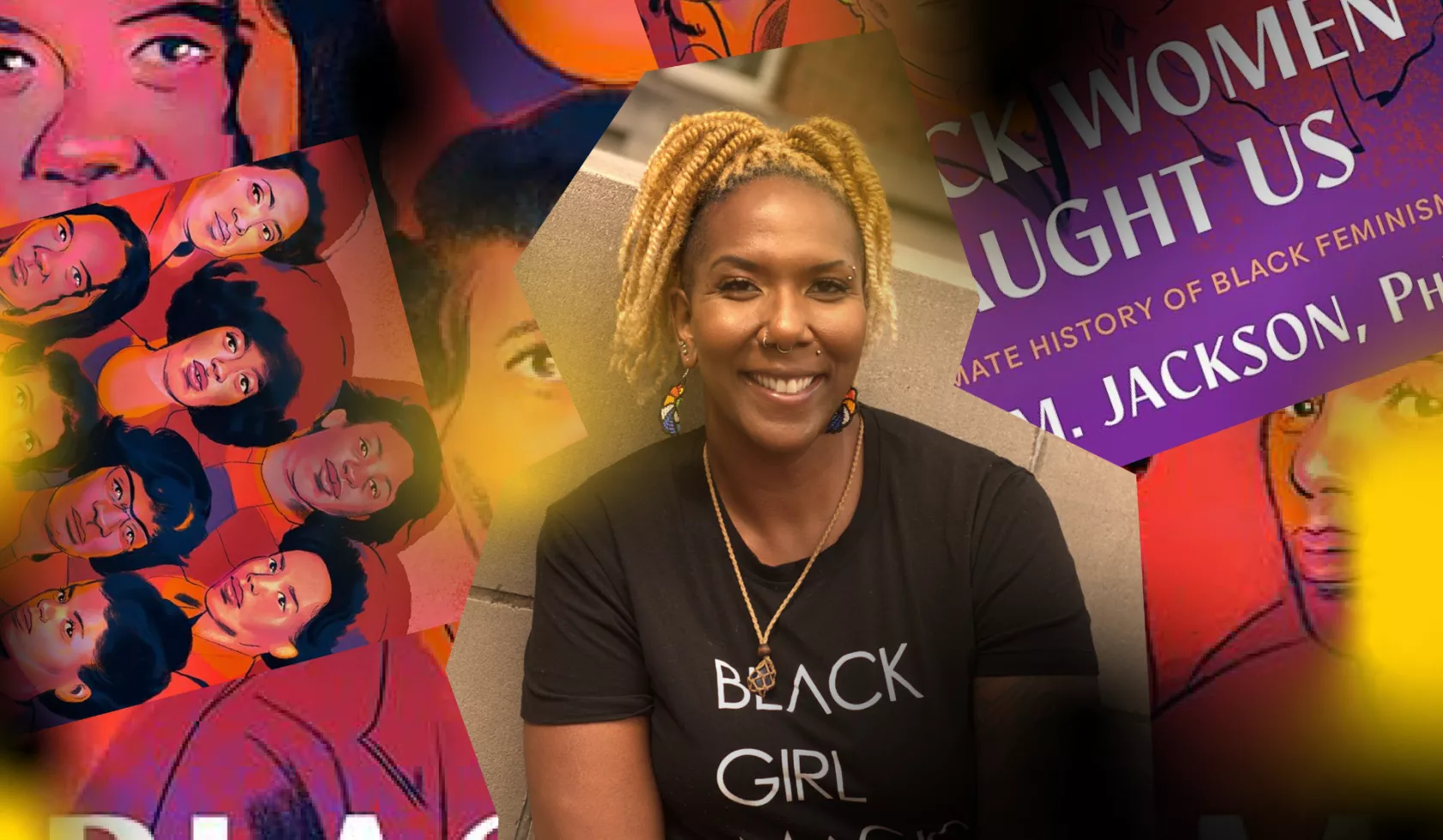
The Culture Shelf: Black Women Taught Us
Throughout history Black women have taken care of our families and our communities. They have set trends They have supported and led the fight for voting rights, social justice, and equitable healthcare and education.
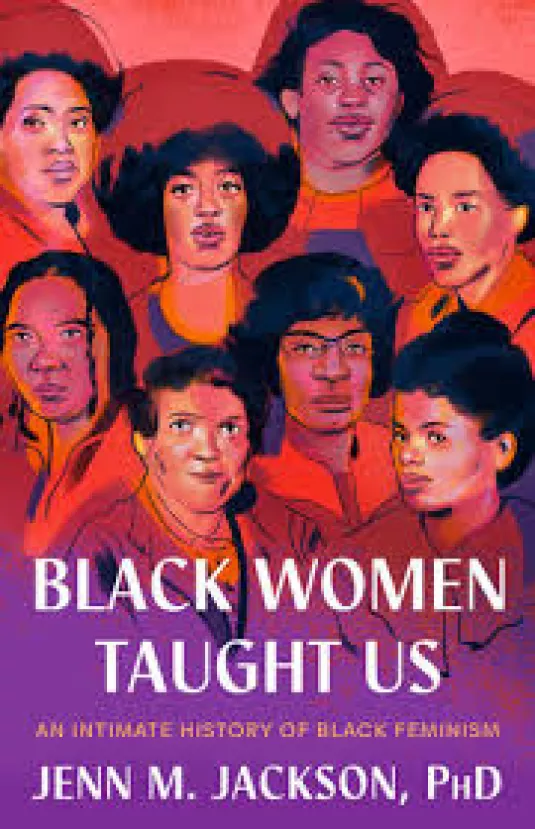
In her book Black Women Taught Us: An Intimate History of Black Feminism, Jenn M. Jackson, PhD doesn't just revisit history, she centers Black women as the originators of so many frameworks for justice, care, and resistance.
"My mother is the first Black feminist teacher I've ever had. This book is for my mother" Jackson said. "This book is for my mother's mother, who was a devout pastor who was a light in my life. So when I say Black women taught us, sure, I'm talking about Audre Lord, I'm talking about Bell Hooks, I'm talking about all the greats that were... But I'm talking about Cynthia Logan, my mother. I'm talking about Lucile Sanders, my grandmother. I'm talking about Claire Logan, my paternal grandmother. Because without them, I wouldn't have been introduced to these women."
A love letter, a history lesson, and a call to action all at once, Jackson explores her own education in Black feminism and explains how the lives of Black women have given us a blueprint for navigating our current reality.
This 2024 interview has been edited (lightly!) for clarity and flow.
Janelle Rucker: Take us on the journey for how you got to this book. Where did the idea come from? Why was this something that you wanted to write and put out into the world?
Jenn M. Jackson, PhD: I tell this story at the start of the book in the introduction. I tell the story of being an undergraduate at the University of Southern California. I was an industrial and systems engineering major, and I was all excited about math and calculus and physics, but I also wanted to learn about myself. I was experiencing racism at school. I'm from Oakland, California. I had been around all these black folk, and now I was around all these white folk, and it was confusing to me. I thought to myself, Oh, I'll take a class, like a Black feminist politics class. And there were none. None were offered on a whole campus. I went through four years of college and could not take a single class in Black feminism. So I graduated, I went and got a job at Disney and was experiencing all this racism and misogynoir and anti-Blackness and white supremacy. And I didn't know the terms, I was just experiencing it. And I called my mother on the phone, and I was like, "Mom, I need help. Help me understand what's happening to me." I remember sitting at the foot of my mother's bed and her reading these books by all these Black women.
So I said, Who were those women? She said, Start with Alice Walker and then move to Terry McMillan. When I went into Borders Bookstore, I went to the section where all the Black writing were. The first book I saw was Melissa Harris-Perry's Sister's Citizen. On the cover of the book was this Black woman. She had a bald head, and she had a flag on her head. I was like, I want to know what's in that book. So I picked it up and I began reading it. And in this book were these concepts, like the sapphire, the angry black woman, the Jezebel, the over sexualized black woman, the Mammy, the asexual black woman who only wants to care for white children and their families. And I'm in Border's literally crying into the book. I started reading about what she calls the Crooked Room and the Crooked Room is this phenomenon where essentially, Black women are expected to move in society in these stereotypes that do not fit our bodies.
I took that book and I read everything in the bibliography. I followed all the readings that she cited, and I found Bell Hooks, I found Audre Lord, and I found Dr. Cathy Cohen, who is a political scientist at the University of Chicago. That changed the whole arc of my career because after that, I was like, Well, I got to quit my job. You got to go to the University of Chicago. I'm going to PhD. And that's what I did. And this book is the culmination of that journey. This book is an anthology, an archive of that entire journey to becoming who I am today from that day.
JR: In all the research and the readings that you've done, if you can sit any other black woman down, and you only get one book that they can read that to send them on their journey, what book would that be?
Jackson: I don't want to be egotistical. I don't want to sound arrogant, but honestly, it would be my book. Because my first thought was Zora Neill Hurston, Their Eyes Were Watching God, because I picked up Zora Neale Hurston when I was 11 years old, and that book changed my life. I would want to say Beloved, thinking about Toni Morrison, whose work I believe she was the greatest writer of all time. But if I was thinking about setting someone on their Black feminist journey, that is the reason why I wrote this book. The reason why I wrote this book was so that no more young Black women or young Black curious people who were wondering about our lives would have to walk around in these predominantly White institutions and this White supremacist world asking what is happening to me? This book is meant to answer that question, and it's meant to answer all facets of that question. So I would actually say, Black Women Taught Us.
JR: There are a lot of people who don't realize that there's a difference between Black feminism and feminism. What is your easiest way to explain the difference and why there needs to be a difference?
Jackson: Yeah. Mainstream feminism or mainstream white feminism is concerned with the ways that white women have historically set themselves apart from their male counterparts. That is the origin of mainstream white feminism. That doesn't really have anything to do with us. The first wave was about white women feeling like they were enslaved by their husbands, which is interesting because they were simultaneously enslaving Black folk. The second wave, they're thinking about how to begin having their own labor security, their own ways to work outside of the home. The third wave is thinking about reproductive justice and the way that they can have their own ownership of their sexual identities and their bodies. Fourth wave is thinking about who they are and how we think about our identities. That's how white women understand themselves. Unfortunately for black women, our struggles have always been different, because those same white women were enacting policies and supporting very powerful, very wealthy capitalist structures that kept black women in systems of oppression. So for black women, a lot of us start our conversation about Black feminism in 1892 with Anna Julia Cooper and Ida B. Wells. These were women who were not considered a part of that mainstream feminist struggle. These were people who were considered too radical. The things they wanted were too big.
Black feminism is inherently different and has been because we are inherently different. Our needs are inherently different. Our politics are inherently different. And the way that our labor is exploited, our bodies are exploited, our rights are taken away. All of that is inherently different.
JR: Why these women? Talk to us about why this set of women that you have in the book.
Jackson: I'm a professor at Syracuse University. I'm a nerd. I'm a political scientist. There are things that really matter to me with my students, and one of them is introducing them to American government and telling them the honest truth about it. And teaching my Black Feminist Politics course, and telling them the real truth about Black women's experiences in the U.S. So this book is also the result of my teaching young people. So these women who are included in the book are also the women I include on the syllabus of my course.
Each of them represents a particular lesson that I needed on my journey. This is almost chronologically the order in which I discovered these women, almost to the letter. Harriet Jacobs, I include specifically on the concept of freedom, because this was something I actually was really struggling with for a long time as an organizer, Coming to the idea of freedom. I include this lesson on freedom to actually help folk navigate it in the ways that I did.
I talked about Ida B. Wells and the idea of truth-telling and how Black women often do that at great peril, at great risk to their own lives. I talk about Zora Hurston, who changed my life. But not only that, when I found out the conditions of her life, they were so astounding to me to know that she had changed my life. I talk about Fannie Lou Hamer, who I had never heard of. It upset me because I had heard her phrases and her quotes and never had heard her name. And that resonated with me because she died at 60 years old, and on her death certificate, they said she was a housekeeper. It reminded me how when you're unrespectable in those ways, they will simply just rename you and erase you. I talk about Ella Baker. At some point, you're the organizer. You're out there on the streets, you're doing the die-ins, and you're doing all this stuff. Then one day, you too old. At some point, I realized that I was an elder. I was an organizing elder, and people were coming to me and looking to me to help them to strategize and to create movements. And it just reminded me so much of the Ella Baker that I had studied. I talk about Shirley Chisholm, and this was another person who I knew very little about growing up. And when I learned about how she would hold white people and white institutions accountable and how she was fearless - they called her Fighting Shirley Chisholm - it was inspiring for me because I felt as though this was a story that people didn't want told.
I close the book talking about Bell Hooks. When I first wrote the book, Bell Hooks was very much alive. I believe that she had much more time left. That's one of the things that I think is our mistake as community members and lovers of Black women. The book is really asking us not to do that and to be careful about that. Bell Hooks was alive, and it was late in the book's development. The book had actually been sent in, the draft was in, and it was during COVID. My grandmother passed away, a dear friend of mine, Lauren Ballant, passed away, and Bell Hooks passed away. I remember this deep guilt falling over me. I realized it was because I had left her out. I had learned so much from her, and I felt like I took her for granted. I felt like I did the very thing I had written this book not to do. I had mentioned her, but the fact that I didn't give her a chapter when she was one of the first books I read after I opened Melissa Harris-Perry. That last chapter on love and Bell Hooks is really a eulogy. It's an apology. It's a chapter to say, I'm sorry, and I'm guilty of it, too.
Whenever we talk about loving black women, we're so excited about it, and we're always talking about protect Black women and believe Black women. But when it comes down to it, what does that look like? What are we actually doing? Do we actually show up? Is it active? Is it ongoing? Do we do it every single day? And I had to admit that I wasn't doing it.
JR: Of all of the women who are included in the book, is there any one or maybe a few through-threads that have been common to Black womanhood over time that you discovered?
Jackson: Yes, and it's really sad. It's like when you write a book and you revise and you revise and you revise, these things start to bubble up and you start to notice them. The thing that comes up, I remember the most, when I started doing this work and I started to notice how young so many of these women were when they passed away. So many of them were dying between 60 and 70. They were dying of largely preventable or treatable ailments, a lot of cancer, a lot of hypertension. Even this The concept of Zora Neal Hurston dying of malnutrition is just astounding to me. In 1960, right? Reading these accounts of how these women's lives turned out. They struggled so hard for us. Then in their golden years, folks weren't struggling for them. It struck me because a few years ago, I remember seeing on Twitter and on social media, a GoFundMe for Barbara Smith, one of the founders of the Combine. I remember being enraged. I remember being enraged because I was like, How do we get here? Another [thread] was that for a lot of these women, they didn't really catch on to their own fragility in their own vulnerability until later in their life. I think a lot about this with Audre Lord, because people associate her with a self-care movement, but a lot of folks don't realize that her work on self-care really started when she was diagnosed with cancer. She's writing as she's looking at her own mortality, as she's thinking about what's going to happen with her life.
JR: The book is Black Women taught us. It's a lot of looking back on how it informs us now. What about black women who are teaching us?
Jackson: At the end of the book, in the conclusion, I actually give a whole list of other Black feminists who I didn't give a chapter, but who are so important. One of them, who is actually a dear friend of mine, is Brittany Cooper who I think is prolific and one of the most accessible and kindest Black feminist scholars I have ever encountered in my life. Her article on intersectionality in the Oxford edition on Black Feminism is one of the best things I've ever seen written on intersectionality.
I obviously mentioned folks like Cathy Cohen. She's my advisor, but Cathy is a subtle and quiet powerhouse. She is not only a Black feminist scholar, but a queer feminist scholar and she does so effortlessly. Barbara Ransby, I mentioned also in that chapter, Barbara Ransby is a radical Black historian from Chicago, and she is a thug, and she's about that life. One person who I don't think folks give enough credit to for her from this work is Janet Mock. Janet Mock's first book, Redefining Realness, is incredible. I really love her first book because of the way she is intentional about understanding how important it is to speak to multiple audiences about her Coming of Age narrative as a trans woman of multiple racial identities. It's such a beautiful intersectional narrative. If you ever want to understand what intersectionality is in real-world terms, that book is Is It. There's a couple more in there. I could go on literally forever. I do want to mention who I think folks love, but don't put enough respect on her name, is Maryam Kaba. Maryam Kaba is a fierce, consistent abolitionist and liberationist who fights silently, quietly behind most of our major wins for reparations and abolition across this country. If you look at some of our major organizing struggles in New York, in Chicago, DC, Baltimore, in the last 15 to 20 years, she's involved.
JR: Thank you for giving us all a tool, no matter where we are on this journey. Is there anything else that you want folks to know about the book?
Jackson: Everything has a ripple effect. If we keep believing that because these folks passed away 40, 50, 90 years ago, that their lives don't matter or their words are insignificant, we are going to continue to hustle backward. And so this book is meant to say, not only do we care about the history, but we care about the fact that these women already knew. They already knew, and they already told us. That's why it's "black women taught us." They already taught us. And here's how it applies today. So what I want folks to understand, this is not a history book, because history books just tell you the history, and they just send you off on your own. They say, Good luck, right? No, no, no. This book is, Here's the history. Now, put some respect on these Black women's names and do otherwise, right? Do something different.